In May 2024, the Biden DOJ filed United States v. Live Nation Entertainment in the Southern District of New York, joined by 39 state attorneys general and the District of Columbia. The complaint alleged that Live Nation and Ticketmaster had illegally monopolized concert promotion, primary ticketing, and large-amphitheater venue operation in violation of Sherman Act §§ 1 and 2. The coalition was bipartisan. The remedy sought was structural: break up Ticketmaster from Live Nation. The case was assigned to Judge Arun Subramanian. Trial began March 2, 2026.
One week into trial, the Trump DOJ settled. The terms: no breakup, no admission of liability, no money to the Treasury. Live Nation keeps Ticketmaster. The behavioral remedies consist of a fee cap that applies only to the handful of amphitheaters Live Nation itself owns — a small fraction of Ticketmaster's business — an "open ticketing" API, and an eight-year extension of the same 2010 consent decree that Live Nation was already found to have violated in 2019. A Harvard antitrust scholar called the deal a "Band-Aid." The DOJ's own trial team and all 39 state co-plaintiffs were kept in the dark until hours before the public announcement. Judge Subramanian learned by email at 8 p.m. the night before, received the actual term sheet at 6:30 a.m. the next morning, and took the bench to call the concealment "absolutely unacceptable" and "absolute disrespect for the court, the jury, and this entire process."
The circumstances under which this settlement materialized are not subtle. Live Nation contributed $500,000 to Trump's inaugural committee and spent $1.8 million on federal lobbying in 2025. It put Trump envoy Richard Grenell on its board while the case was pending. The Wall Street Journal reported that Trump personally pressed for the settlement after Hollywood agent Ari Emanuel — a Live Nation board member — lobbied him directly. The DOJ's Senate-confirmed antitrust chief, Gail Slater (confirmed 78-20), was ousted in February 2026, weeks before trial. Her deputy Roger Alford had been fired the previous summer. Alford, now at Notre Dame, has since stated publicly that Live Nation "paid a bevy of cozy MAGA friends to roam the halls of the Antitrust Division" in its defense, naming AG Bondi's chief of staff as the internal conduit. The term sheet was finalized at a March 5 White House meeting. Senator Amy Klobuchar's assessment: "Every single sign points to a backroom deal." Six senators wrote Judge Subramanian formally requesting heightened Tunney Act scrutiny of a settlement they characterized as the product of political pressure rather than the public interest.
Thirty-three states and D.C. rejected the deal and continued the trial alone. On April 15, 2026, after four days of deliberation, a federal jury found Live Nation liable on every claim put to it: monopoly maintenance in primary ticketing services for major concert venues (where Ticketmaster holds 86% market share), monopolization of the large-amphitheater market, and unlawful tying of promotion services to venue access. The jury found Ticketmaster overcharged buyers $1.72 per ticket across 22 states — a figure that will be trebled under Clayton Act § 4. Key trial evidence included testimony from a former Barclays Center CEO that Live Nation threatened to pull concerts if the venue switched ticketing providers, and internal company Slack messages in which one employee wrote "Robbing them, blind, baby, that's how we do" — messages that CEO Michael Rapino disavowed on the stand as "disgusting."
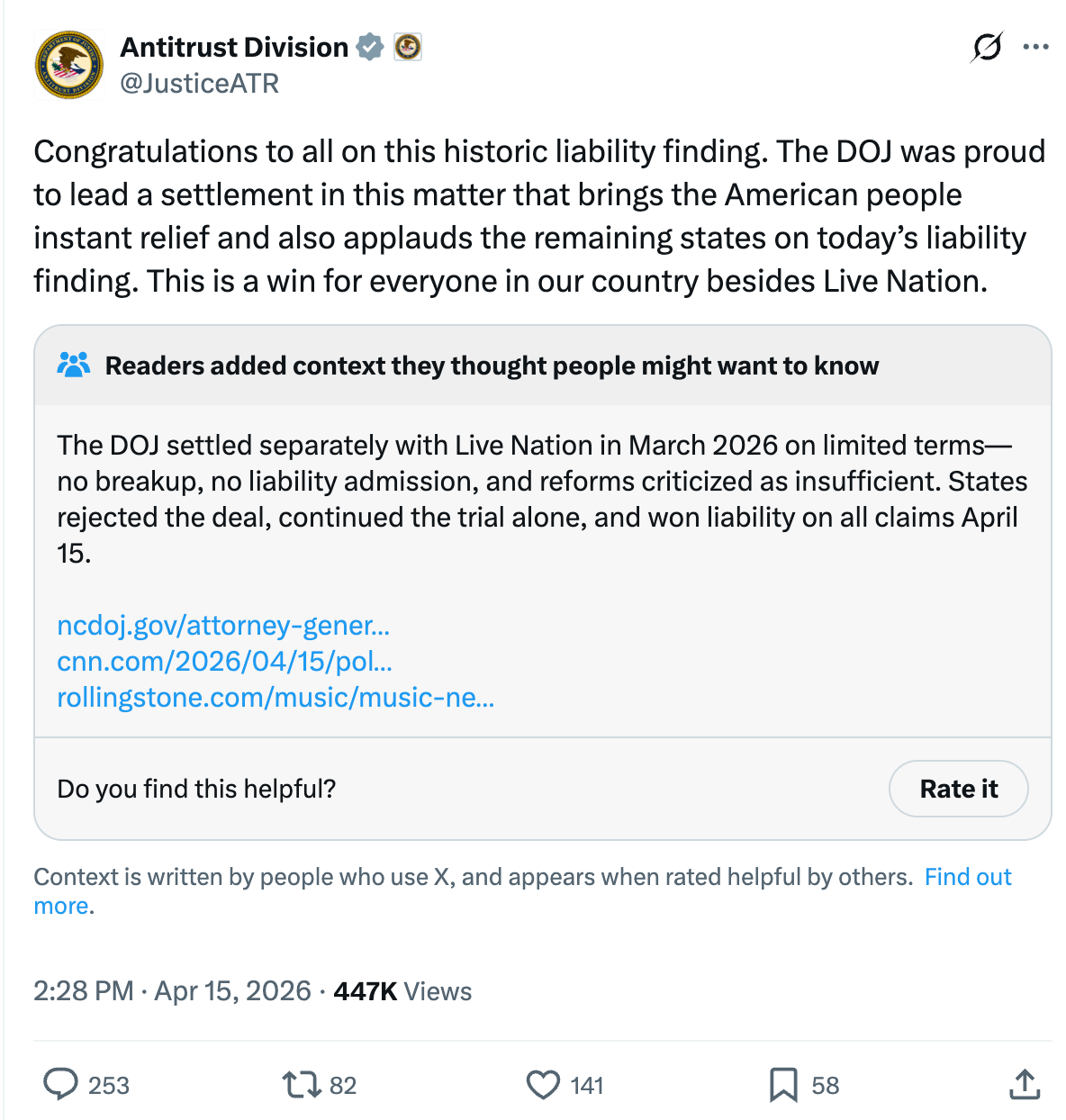
The DOJ's Antitrust Division posted a congratulatory tweet within hours of the verdict, calling it "a win for everyone in our country besides Live Nation." Acting AAG Omeed Assefi issued a statement declaring the outcome "fantastic" and claiming that "everyone but Live Nation wins with this scenario." The states that actually tried the case saw it differently. California AG Rob Bonta called it a "historic and resounding victory for artists, fans, and fair competition" achieved "in the face of dwindling antitrust enforcement by the Trump Administration." Ousted AAG Gail Slater credited the state coalition on X for making "antitrust history" — pointedly not crediting the agency that fired her. Roger Alford called it "a massive win for the state AGs and an historic miss for the DOJ."
The DOJ's settlement is still pending Tunney Act approval before Judge Subramanian — the same judge who just watched 33 states prove everything the DOJ gave away. He now has a jury verdict on his docket establishing that Live Nation is an illegal monopoly, that it overcharged consumers, and that behavioral remedies of the exact type the DOJ settlement relies on already failed once under the 2010 consent decree. He has every factual and legal predicate he needs to reject the settlement as not in the public interest. The states have a full liability verdict to build a breakup order on. And the DOJ congratulated everyone on the win — which is now the same DOJ that backstabbed every American who's ever bought a concert ticket.
Table of Authorities
- United States v. Live Nation Entertainment, Inc., No. 1:24-cv-03973 (AS) (S.D.N.Y.)
- Sherman Act, 15 U.S.C. §§ 1, 2
- Clayton Act § 4, 15 U.S.C. § 15 (treble damages)
- Antitrust Procedures and Penalties Act ("Tunney Act"), 15 U.S.C. § 16(e)
- United States v. Live Nation Entertainment, Inc., Consent Decree (2010), modified 2020
- DOJ Antitrust Division, Statement of Acting AAG Omeed A. Assefi (Apr. 15, 2026)
- Letter from Sens. Klobuchar, Warren, Booker, Blumenthal, Hirono & Welch to Judge Subramanian re: Tunney Act Review (Apr. 2026) — Variety
- Live Nation Entertainment, FEC Inaugural Committee Disclosure ($500,000, 2025)
- Live Nation Entertainment, OpenSecrets Federal Lobbying Profile ($1.8M, 2025) — OpenSecrets
- Wall Street Journal, reporting on Trump/Emanuel involvement in settlement (Mar. 2026) (verify original WSJ article)
- Harvard Gazette, "For Now, Live Nation Deal is Just a 'Band Aid,' Says Antitrust Scholar" (Mar. 2026) — Harvard Gazette
- NPR, "Jury finds that Live Nation acted as a monopoly and overcharged ticket buyers" (Apr. 15, 2026) — NPR
- CNN, "Jury finds Live Nation and Ticketmaster operated as a monopoly and overcharged fans" (Apr. 15, 2026) — CNN
- Rolling Stone, "Live Nation Operated as a Monopoly, Jury Finds" (Apr. 15, 2026) — Rolling Stone
- Billboard, "Live Nation Verdict: Jury Says Concert Giant Is An Illegal Monopoly in Total Defeat" (Apr. 15, 2026) — Billboard
- The American Prospect, "States Substitute for Corrupt Feds on Antitrust" (Mar. 17, 2026) — Prospect
- Matt Stoller, BIG Newsletter, "Trump Just Pardoned Ticketmaster When No One Was Looking" (Mar. 2026) — BIG
Legalish is supported by Lynch LLP — Trademark · Copyright · Patents


