Cardi B Got Sued for Posting a Photo of Herself. She Might Lose.
A lawsuit filed yesterday in the District of New Jersey presents one of copyright law's most counterintuitive propositions: a person can be liable for copyright infringement for posting a photograph of themselves. Under U.S. copyright law, the photographer who takes a picture owns it, not the person in it. That feels especially strange when the plaintiff isn't very sympathetic — like a paparazzi.
If you're not a copyright holder, be careful.
The plaintiff is Ramales Photography LLC, the entity of Felipe Ramales, a New York-based paparazzi photographer. The defendant is Belcalis Almanzar, known professionally as Cardi B. The photograph at issue shows her walking down a Manhattan street on July 2, 2022.
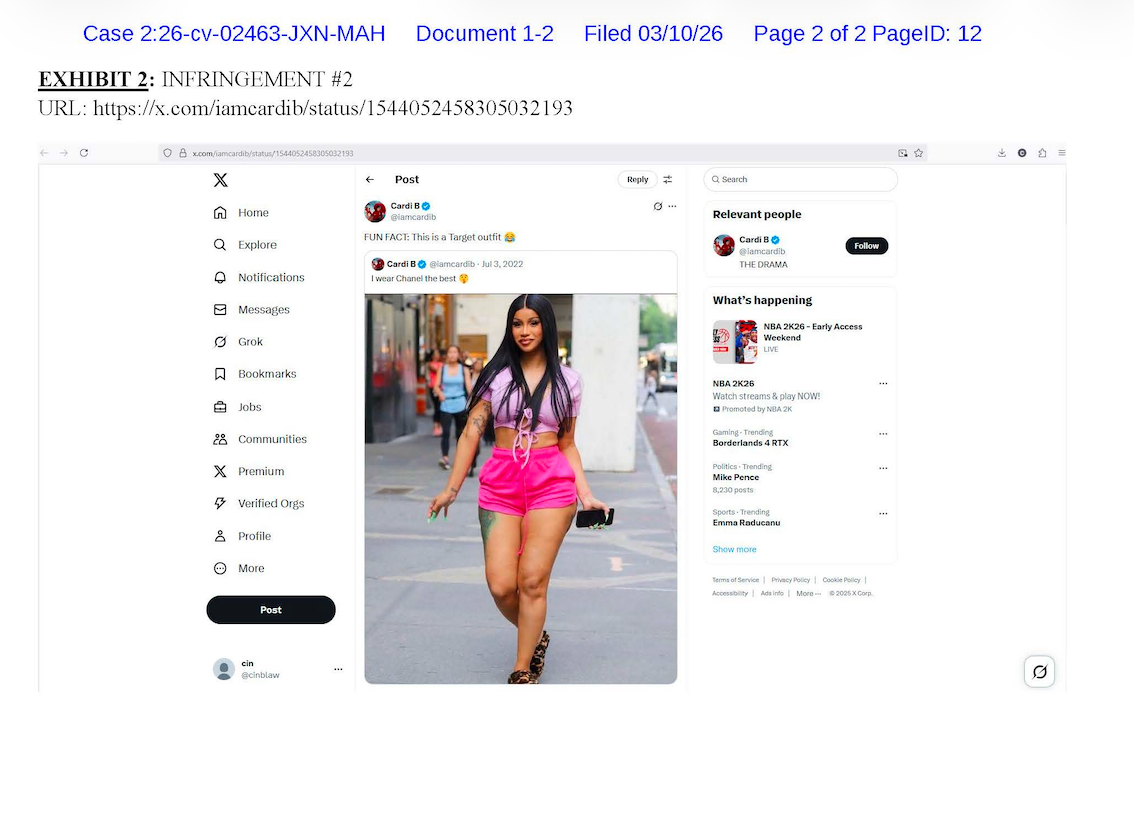
Ramales registered it with the U.S. Copyright Office six weeks later. Cardi B posted it to her X account twice — the first time captioned "I wear Chanel the best," the second time as a quote-tweet of the first, captioned "FUN FACT: This is a Target outfit." Ramales sent demand letters in June and August 2024. She did not respond. The complaint was filed March 10, 2026.
The legal framework here is not exotic. Under the Copyright Act, protection attaches the moment a creative work is fixed in a tangible medium of expression — which is a formal way of saying that if you make something, you own it automatically, without registration, without a notice, without doing anything at all. Under 17 U.S.C. § 106, that ownership comes with the exclusive rights to reproduce and publicly display it. The author of a photograph is the person who made the creative decisions behind the camera — framing, timing, angle, depth of field — not the person standing in front of it. Appearing in a photograph confers no copyright interest in it whatsoever. This is not a loophole or an oversight. It is the statute operating exactly as designed.
What makes this case instructive beyond its facts is what the second post reveals about the doctrine of willfulness. Cardi B did not merely share a candid photo of herself. She used it to make a commercial point — product attribution, brand association, audience engagement — on an account the complaint describes as integral to her commercial enterprise. The Copyright Act permits statutory damages of up to $150,000 per work for willful infringement. Willfulness does not require malice. It requires that the defendant knew, or had reason to know, that the conduct constituted infringement. Using a professionally-taken paparazzi photograph to promote your brand, after receiving two cease-and-desist letters, is not a great set of facts for Cardi.
The deeper lesson is that copyright law routinely produces outcomes that feel wrong to ordinary intuition. The subject of a photograph has no automatic right to control it. The person who took the photo at a public event, on a public street, of a public figure, owns it. The celebrity's fame — the very thing that makes the photograph commercially valuable — belongs entirely to the photographer for purposes of licensing.
This tension is not unique to celebrities. It surfaces whenever someone reposts a news photograph, embeds a press image in a blog, or shares a professional headshot without a license. The instinct that "it's a picture of me" translates into a legal right is understandable. Copyright law does not share that intuition.
Whether Ramales prevails will depend on facts not yet in the record — including what, if anything, Cardi B's team understood about the image's origin and licensing status. But the threshold question the complaint raises is not a close one. The photograph was registered. It was posted without authorization. The posts remained up after written notice.